Squirrel Hill Tunnel At a total cost of $18 million, the Squirrel Hill Tunnel was the most costly single project built by the State Highways Department and completed the last link in the first eight-mile section of the Penn-Lincoln Parkway. (Detre Library & Archives, Sen. John Heinz History Center)
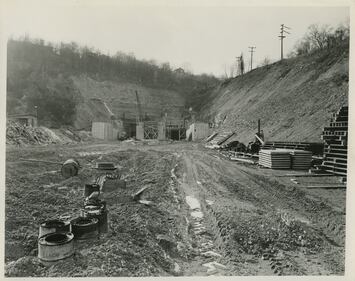
Squirrel Hill Tunnel Construction of the Squirrel Hill Tunnel. Picture taken in 1949. (Archives & Special Collections, University of Pittsburgh Library System)
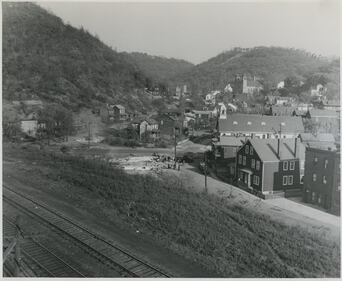
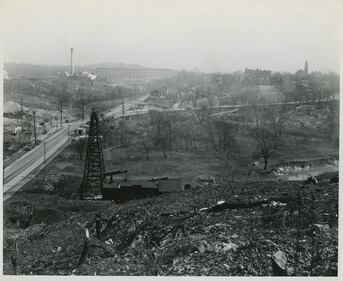
Squirrel Hill Tunnel Frazier Street at Junction Hollow, where the Parkway East's approach to the Squirrel Hill Tunnel would be build. Junction Hollow divides Schenley Park from the rest of Pittsburgh’s Oakland neighborhood by a 150-foot-deep gorge. The early residents of that community knew the hollow as Four-Mile Run. Four-Mile Run’s name was derived from its distance to the Point in downtown Pittsburgh. The current name refers to the tracks of the Pittsburgh Junction Railroad that were laid here in 1884-86. This area has also been referred to as the Saline Valley. The wood frame church near the center of the photograph is Saint Joachim’s Roman Catholic Church. The church in the far background is Saint John Chrysostom Byzantine Catholic Church where famed pop artist Andy Warhol was baptized. (Detre Library & Archives, Sen. John Heinz History Center)
Squirrel Hill Tunnel Construction of the Squirrel Hill Tunnel. Picture taken in 1949. (Archives & Special Collections, University of Pittsburgh Library System)
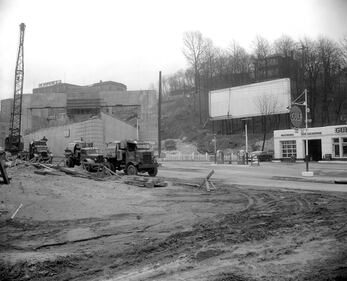
Squirrel Hill Tunnel Looking east toward Swissvale and Edgewood, the Union Switch and Signal Building can be seen in the center background. This was the future route of the Parkway East. The first contract for preparing the plans for the new Penn-Lincoln Parkway was given to Michael Baker, Jr. of Pittsburgh in November 1943. The estimated cost of the project at the time was $20 million. The figure was underestimated because the Squirrel Hill Tunnel itself cost $18 million to build, the most expensive project ever undertaken by the Pennsylvania Department of Highways at the time. The Squirrel Hill Tunnel was dedicated on June 5, 1953. (Detre Library & Archives, Sen. John Heinz History Center)
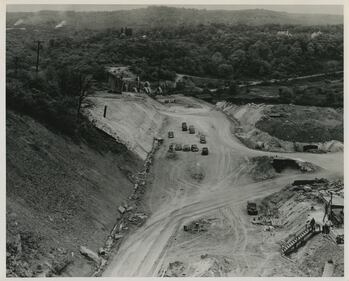
Squirrel Hill Tunnel Eastern portal of the Squirrel Hill Tunnel under construction. The Department of Highways on August 5, 1948, announced that construction of the Squirrel Hill Tunnel would begin on September 1 of that same year. At a total cost of $18 million, it was the most costly single project built by the State Highways Department and completed the last link in the first eight-mile section of the Penn-Lincoln Parkway. The total length of the tunnel is 4,225 feet with a posted vertical clearance of 13 feet, 6 inches. The width of the tunnel is approximately 28 feet. The Squirrel Hill Tunnel was dedicated on June 5, 1953. (Detre Library & Archives, Sen. John Heinz History Center)
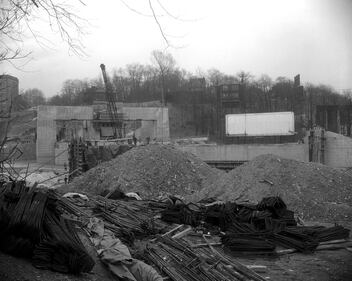
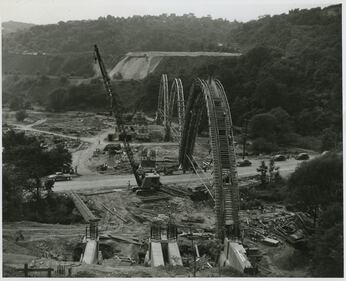
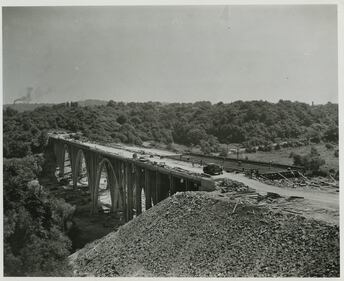
Squirrel Hill Tunnel Initial phase of the construction of the Commercial Street Bridge along the Penn-Lincoln Parkway, as viewed from the near the site of the Squirrel Hill Tunnel's eastern portals. The bridge has 3 arches with a length of 170 feet each and 12 approach spans at a length of 28 feet each. The total length of the bridge, including the longest elevated ramp, is 846 feet. The height of the deck has a clearance of 85 feet at the arch and a width of 68 feet. The bridge, a pair of twins each featuring two-ribbed arches, includes nearly 2.5 million pounds of steel reinforcing bars and 15,000 cubic yards of concrete. Material excavated during the construction of the Squirrel Hill Tunnel fills a part of Nine Mile Run Valley to a depth of 100 feet on a 1,000 foot long approach to the Commercial Street Bridge. Construction began in April 1948 and was completed in April 1951 at a cost of $1.78 million by Dinardo, Inc. of Pittsburgh. (Detre Library & Archives, Sen. John Heinz History Center)
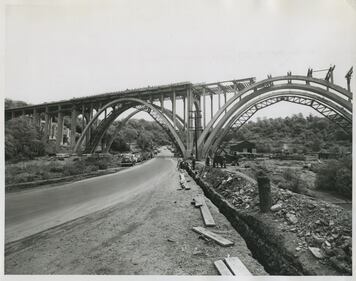
Squirrel Hill Tunnel Construction of the Commercial Street Bridge along the Penn-Lincoln Parkway (Interstate 376), or known locally as the Parkway East. The bridge has 3 arches with a length of 170 feet each and 12 approach spans at a length of 28 feet each. The total length of the bridge, including the longest elevated ramp, is 846 feet. The height of the deck has a clearance of 85 feet at the arch and a width of 68 feet. The bridge, a pair of twins each featuring two-ribbed arches, includes nearly 2.5 million pounds of steel reinforcing bars and 15,000 cubic yards of concrete. Construction began in April 1948 and was completed in April 1951 at a cost of $1.78 million by Dinardo, Inc. of Pittsburgh. (Detre Library & Archives, Sen. John Heinz History Center)
Squirrel Hill Tunnel The Commercial Street Bridge, spanning the Nine Mile Run Valley, under construction along the Penn-Lincoln Parkway (Interstate 376) as seen from near the eastern portals of the Squirrel Hill Tunnel. The total length of the bridge, including the longest elevated ramp, is 846 feet. The height of the deck has a clearance of 85 feet at the arch and a width of 68 feet. The bridge, a pair of twins each featuring two-ribbed arches, includes nearly 2.5 million pounds of steel reinforcing bars and 15,000 cubic yards of concrete. Material excavated during the construction of the Squirrel Hill Tunnel, right foreground, fills a part of Nine Mile Run Valley to a depth of 100 feet on a 1,000-foot long approach to the Commercial Street Bridge. Construction began in April 1948 and was completed in April 1951 at a cost of $1.78 million by Dinardo, Inc. of Pittsburgh. (Detre Library & Archives, Sen. John Heinz History Center)
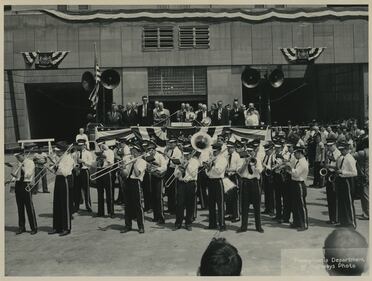
Squirrel Hill Tunnel Taylor Alderdice High School Band in front of the Squirrel Hill Tunnel during the dedication of the Penn-Lincoln Parkway (Interstate 376), or known locally as the Parkway East. The Department of Highways on August 5, 1948, announced that construction of the Squirrel Hill Tunnel would begin on September 1 of that same year. The contract, totaling $13,767,843, was awarded to Perini & Sons, Inc. of Framingham, Massachusetts. This did not include construction of the tunnel lining and highway surface inside the tunnel, nor the ventilating building or pavement of the approaches. At a total cost of $18 million, it was the most costly single project built by the State Highways Department and completed the last link in the first eight mile section of the Penn-Lincoln Parkway. The total length of the tunnel is 4,225 feet with a posted vertical clearance of 13 feet, 6 inches. The width of the tunnel is approximately 28 feet. (Detre Library & Archives, Sen. John Heinz History Center)
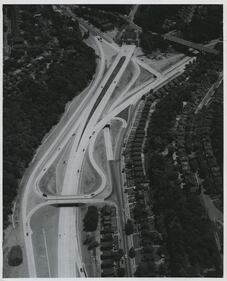
Squirrel Hill Tunnel Caption on the back of the photograph reads, “An aerial view of the Penn-Lincoln Parkway east. Squirrel Hill Tunnel in the rear was one of the major construction tasks in this section, costing about $18,000,000.” The Squirrel Hill Tunnel was the most expensive project ever undertaken by the Pennsylvania Department of Highways at the time. (Detre Library & Archives, Sen. John Heinz History Center)
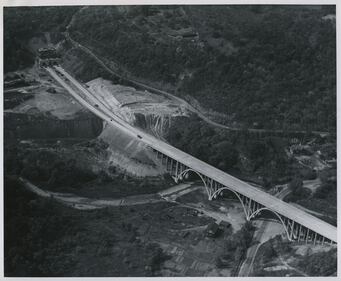
Squirrel Hill Tunnel The Commercial Street Bridge, spanning the Nine Mile Run Valley, along the Penn-Lincoln Parkway (Interstate 376) with the Squirrel Hill Tunnel to the upper left corner. The bridge has 3 arches with a length of 170 feet each and 12 approach spans at a length of 28 feet each. The total length of the bridge, including the longest elevated ramp, is 846 feet. The height of the deck has a clearance of 85 feet at the arch and a width of 68 feet. Construction began in April 1948 and was completed in April 1951 at a cost of $1.78 million by Dinardo, Inc. of Pittsburgh. Material excavated during the construction of the Squirrel Hill Tunnel (left background) fills a part of Nine Mile Run valley to a depth of 100 feet on a 1,000-foot long approach to the Commercial Street Bridge. (Detre Library & Archives, Sen. John Heinz History Center)