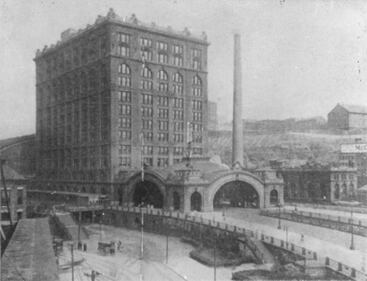
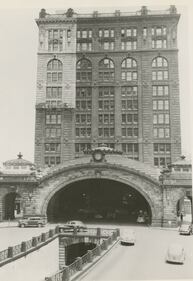
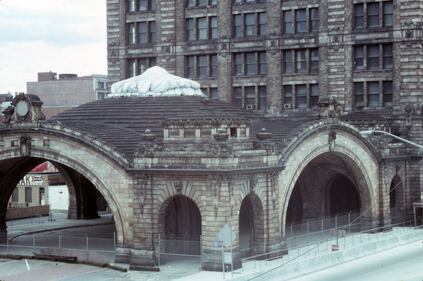
The Pennsylvanian The station, also referred to as Pennsylvania Station and Penn Station was designed by Daniel Burnham and built between 1898 and 1903 with renovations completed in 1954 and 1988. The station is the third building to sit at this location. The first depot was built around 1865 and was burned in the 1877 Pittsburgh railroad riots. A second depot was hastily constructed, lasting until the 1890s when Burnham was hired to design the neo-baroque terracotta and stone building we see today. The station was converted to apartments above, but still serves as the base of operations for Amtrak routes departing from Pittsburgh. Pictured sometime between 1910-1915. (Archives & Special Collections, University of Pittsburgh Library System)
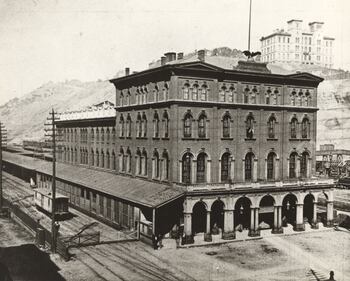
Penn Station The Pennsylvania Railroad Union Depot Building, built in 1857, before it was destroyed by fire during the Railroad Riots of 1877. In late July 1877 while militia tried to disperse a large mob of strikers at the Twenty-eighth Street crossing in the Strip District neighborhood of Pittsburgh, shots were fired and about twenty people, mostly innocent bystanders were killed and a number of others wounded. The mob began breaking into shops and started to seize guns and ammunition, which it used to fire on the militiamen. After the troops began a hasty retreat, looting and burning broke out throughout the City of Pittsburgh. All in all, the mob had destroyed 1600 railroad cars and 126 locomotives and burned sixteen buildings, a grain elevator, several machine shops, roundhouses, and the Union Depot (pictured). In the background is Central High School, built in 1872 and located at Bedford Avenue and Crawford Street. Picture taken around 1870. (Detre Library and Archives, Sen. John Heinz History Center)
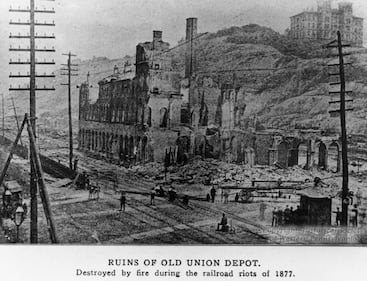
Penn Station The Pennsylvania Railroad Union Depot Building, built in 1857, after the Railroad Riots of 1877. The Pennsylvania Railroad in June of 1877 reduced all wages for its employees by 10 percent and beginning on July 19 of that same year, it declared that all freight trains between Pittsburgh and Derry were to be run as “double-headers,” or two trains, with two engines operated by only one crew. This action resulted in the workers going on strike. In late July 1877 while militia tried to disperse a large mob of strikers at the Twenty-eighth Street crossing in the Strip District neighborhood of Pittsburgh, shots were fired and about twenty people, mostly innocent bystanders were killed and a number of others wounded. The mob began breaking into shops and started to seize guns and ammunition, which it used to fire on the militiamen. After the troops began a hasty retreat, looting and burning broke out throughout the City of Pittsburgh. All in all, the mob had destroyed 1600 railroad cars, 126 locomotives, and burned sixteen buildings, a grain elevator, several machine shops, roundhouses, and the Union Depot (pictured). In the background is Central High School, built in 1872 and located at Bedford Avenue and Crawford Street. Picture taken in 1877. (Detre Library and Archives, Sen. John Heinz History Center)
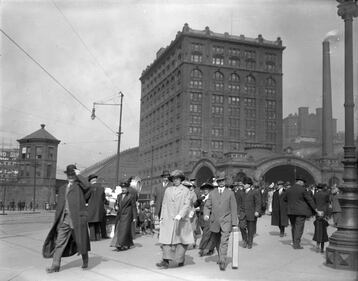
The Pennsylvanian People walk near the Pennsylvania Railroad's Union Station. The station, also referred to as Pennsylvania Station and Penn Station was designed by Daniel Burnham and built between 1898 and 1903 with renovations completed in 1954 and 1988. The station is the third building to sit at this location. The first depot was built around 1865 and was burned in the 1877 Pittsburgh railroad riots. A second depot was hastily constructed, lasting until the 1890s when Burnham was hired to design the neo-baroque terracotta and stone building we see today. The station was converted to apartments above, but still serves as the base of operations for Amtrak routes departing from Pittsburgh. Pictured sometime between 1910-1915. (Archives & Special Collections, University of Pittsburgh Library System)
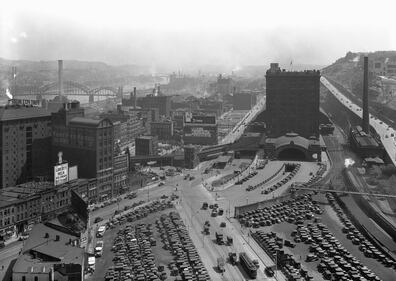
The Pennsylvanian Traffic circle location looking northeast from the top of a downtown building to the Strip District showing Liberty Avenue and Bigelow Boulevard, including the Penn Incline (1883-1953) that connected the Strip District to the Hill District, crossing over Bigelow Boulevard. Picture taken on June 14, 1930. (Archives & Special Collections, University of Pittsburgh Library System)
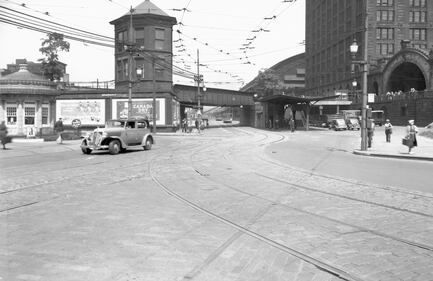
The Pennsylvanian Liberty Avenue looking east from Grant Street showing the Pennsylvania Station and an Atlantic Refining Company Gas Station at the Intersection of 11th Street and Liberty Avenue. Picture taken on July 31, 1936. (Archives & Special Collections, University of Pittsburgh Library System)
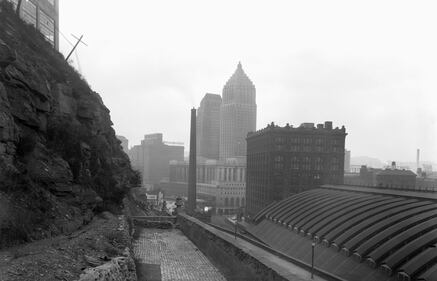
The Pennsylvanian A view of Bigelow Boulevard and rocks overhanging hillside. The Pennsylvania Railroad Station and its large glass platform shed building are visible on the right. Picture taken on September 24, 1936. (Archives & Special Collections, University of Pittsburgh Library System)
Penn Station The Pennsylvania Railroad's Union Station, completed in 1903, in downtown Pittsburgh being cleaned of grime and soot caused by years of air pollution from about 1,293 manufacturing facilities in and around the City of Pittsburgh. Building owners and managers in the Golden Triangle spent more than $2.5 million in removing the grime and smoke from the city’s skyscrapers and office buildings. Picture taken around 1948. (Detre Library and Archives, Sen. John Heinz History Center)
The Pennsylvanian Pennsylvania Railroad Station before it was refurbished. The station is still used today by Amtrak and the old hotel, connected to the station, was turned into an apartment building. Picture taken in October 1985. (Archives & Special Collections, University of Pittsburgh Library System)
The Pennsylvanian The Pennsylvanian
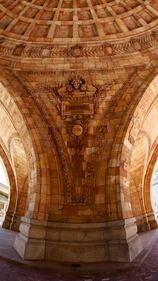
The Pennsylvanian The station became most renowned for its dramatic entry rotunda. The rotunda provided shelter for horse carriages (and later taxis) as they disembarked and embarked passengers at the main doors. Of note, the rotunda’s engravings reflect that they took place during the brief period of time when Pittsburgh was lacking its “H.” The rotunda’s 40-foot vault is topped with a skylight and stands over hand-laid brick flooring. (Tony Ruffolo)