ON THIS DAY: May 4, 1970, National Guard opens fire on Kent State students, killing Churchill woman
ByMatt Simmons, WPXI.com
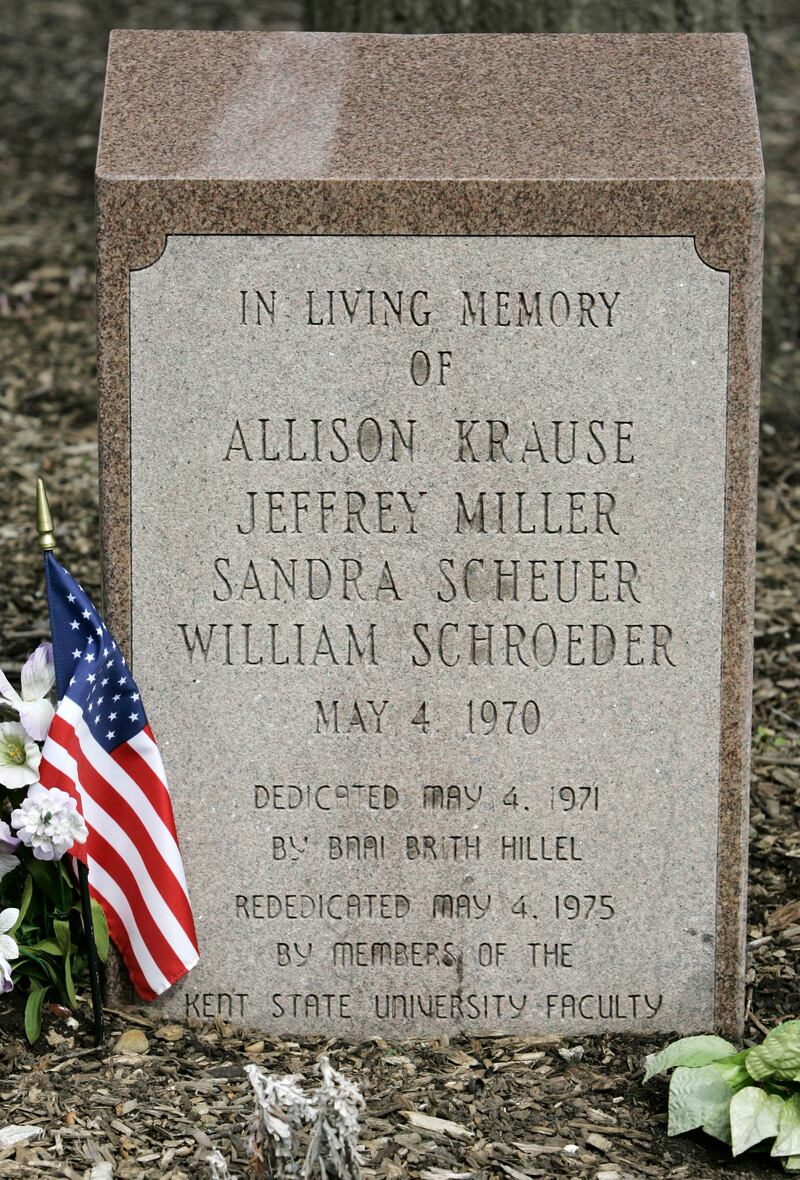
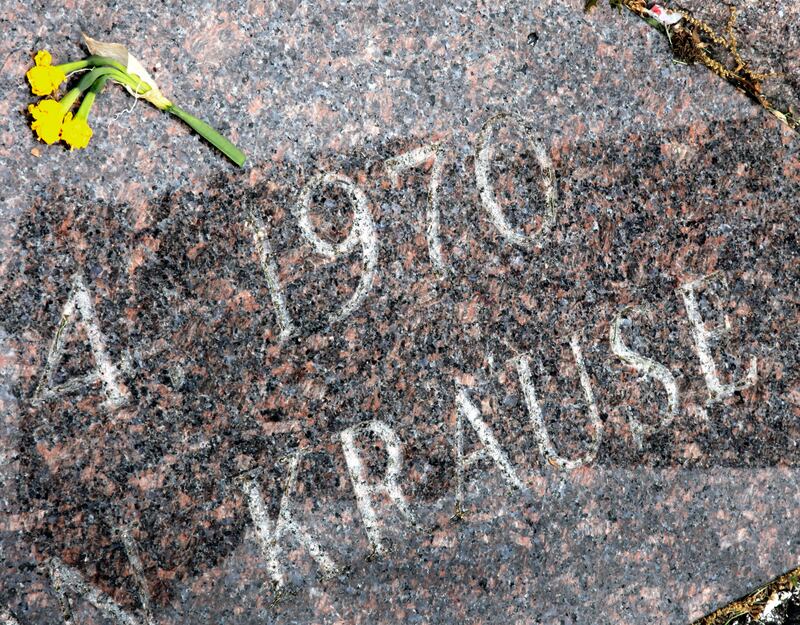
Kent State University shooting A flower lays on the granite marker at the location where student Allison Krause was shot and killed on May 4, 1970 on the campus of Kent State University in Kent, Ohio. (AP Photo/Amy Sancetta) (Amy Sancetta/ASSOCIATED PRESS)
ByMatt Simmons, WPXI.com
KENT, Ohio — National Guardsmen opened fire on students at Kent State University in Kent, Ohio, on May 4, 1970. The students were protesting the invasion of Cambodia and the presence of the National Guard on campus following earlier protests that turned violent. Four people were killed, including honor student Allison Krause, 19, a political science major whose parents lived in Churchill.
Guardsmen fired 67 shots into the crowd in a 13 second volley. Jeffrey Glenn Miller, Sandra Lee Scheuer and William Knox Schroeder were also killed. Gunfire wounded an additional nine students, including one who was permanently paralyzed.
Four students killed at Kent State during protests against Nixon’s Cambodia invasion 50 years ago—William Schroeder, Allison Krause, Jeffrey Miller and Sandra Lee Scheuer: pic.twitter.com/96LhU0TYQJ
Outrage over the “Kent State Massacre” rippled across the country. Student strikes shut down universities and colleges nationwide, the stock market had its biggest one-day loss since President Kennedy was assassinated, calls for impeachment were directed at President Nixon and even soldiers in Vietnam began forming organized resistance to the war.
Born in Cleveland on April 23, 1951, Krause graduated from John F. Kennedy High School in Silver Spring, Maryland, before her parents moved to Churchill where her father worked as an executive for Westinghouse.
The day before the shooting, Krause was with her boyfriend Barry Levine when she said she wanted to talk to the guards at their encampment. Levine said she struck up a conversation with a soldier who had a lilac in his gun barrel, put there by another student. After his commander ordered the soldier to remove it, Krause offered it back, saying “What’s the matter with peace? Flowers are better than bullets!” Her proclamation would soon become a national anti-war mantra.
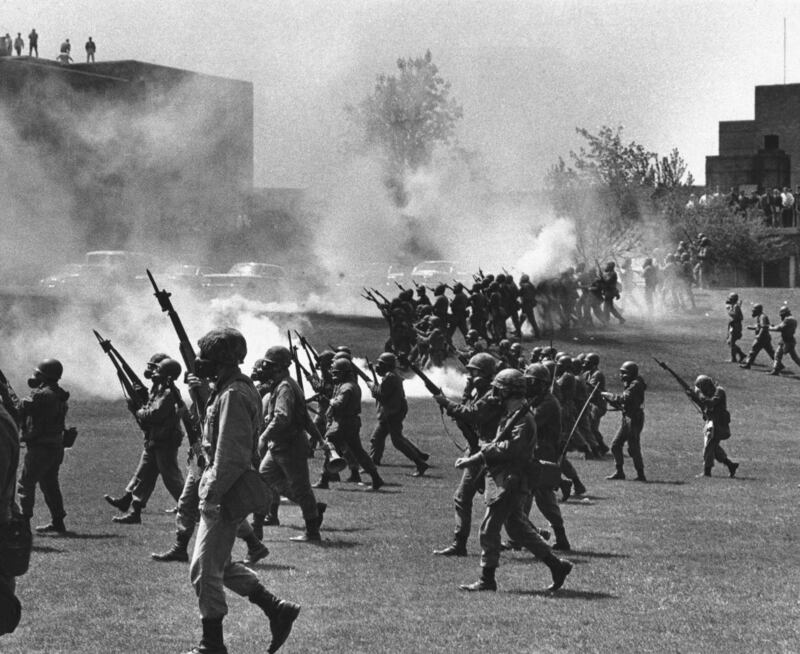
As student protesters faced off with the National Guardsmen on May 4, the soldiers fired tear gas at the rally. The guardsmen fixed their bayonets and several students were cut as the soldiers pushed protesters back. The bloodshed further enraged the students and attracted the attention of bystanders, most of whom were students between classes. When the soldiers reached the top of an area called Blanket Hill, they spun and fired on the crowd in the parking lot below.
Miller and Krause likely had been protesting. Scheuer and Schroeder were simply passing by after classes were canceled. The President’s Commission on Campus Unrest found no evidence that the students posed any immediate threat to the soldiers, despite claims the students were throwing rocks. The nearest student injured was at least 20 yards away. Miller was the closest person killed, at least 85 yards away from the soldiers.
Kent State University shooting Student Kari Coffin sits on the spot in the Taylor Hall parking lot on the campus of Kent State University at sunrise Tuesday, May 4, 1999, where student Allison Krause was killed May 4, 1970, by a bullet fired from an Ohio National Guardsmen during anti-war protests. (AP Photo/Jeff Glidden) (JEFF GLIDDEN/ASSOCIATED PRESS)
Kent State University shooting FILE - In a May 4, 1970 file photo, Ohio National Guard moves in on rioting students at Kent State University in Kent, Ohio. Four persons were killed and eleven wounded when National Guardsmen opened fire. The U.S. Justice Department, citing "insurmountable legal and evidentiary barriers," won't reopen its investigation into the deadly 1970 shootings by Ohio National Guardsmen during a Vietnam War protest at Kent State University. Assistant Attorney General Thomas Perez discussed the obstacles in a letter to Alan Canfora, a wounded student who requested that the investigation be reopened. The Justice Department said Tuesday, April 24, 2012 it would not comment beyond the letter. (AP Photo, File) (AP)
Kent State University shooting Ohio National Guardsmen throw tear gas at students across the campus lawn at Kent State University during an anti-Vietnam War demonstration at the university on May 4, 1970. The Guard killed four students and wounded nine. (AP Photo) (AP)
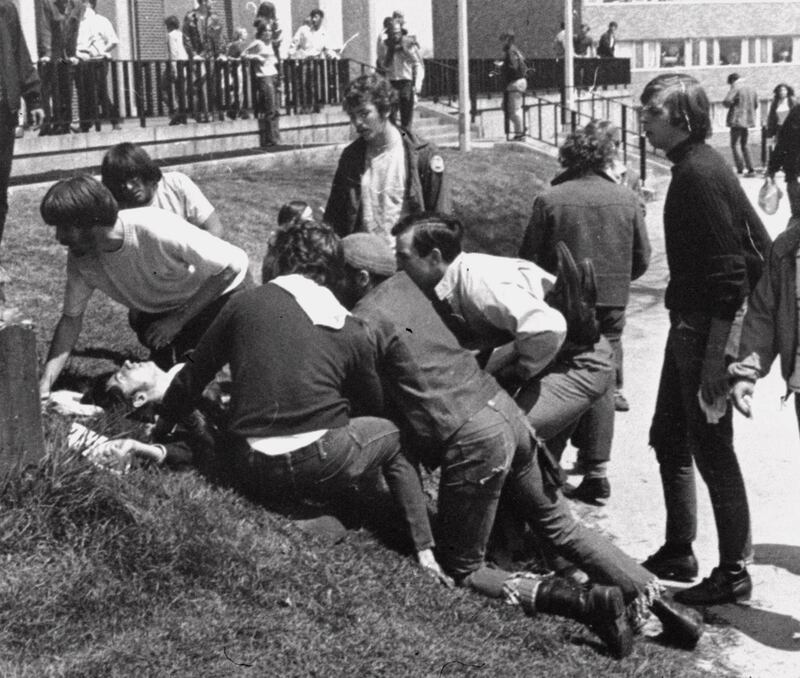
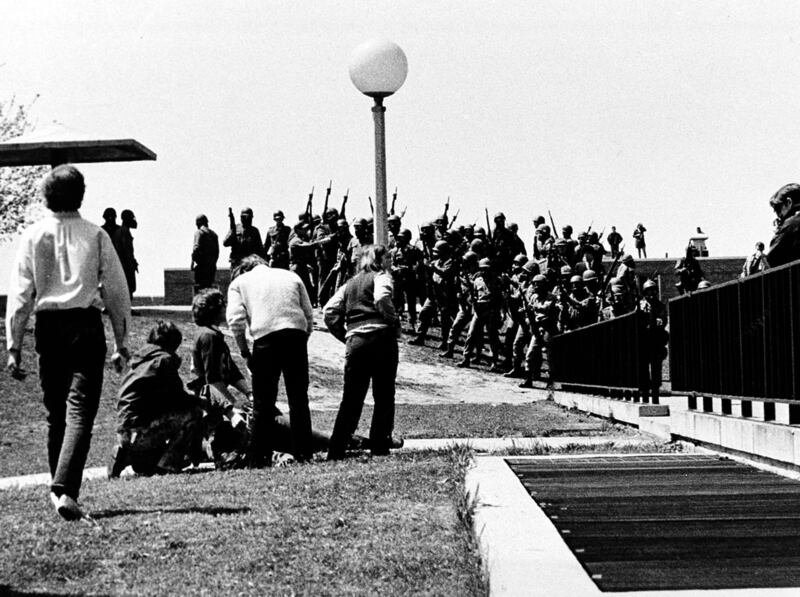
Kent State University shooting A Kent State University student lies on the ground after National Guardsman fired into a crowd of demonstrators on May 4, 1970 in Kent, Ohio. (AP Photo) (ASSOCIATED PRESS)
Kent State University shooting In a May 4, 1970 file photo, a group of youths cluster around a wounded person as Ohio National Guardsmen, wearing gas masks, hold their weapons in the background, on Kent State University campus in Kent, Ohio. Members of the Guards killed four students and injured nine during a campus protest against the Vietnam War. The U.S. Justice Department, citing "insurmountable legal and evidentiary barriers," won't reopen its investigation into the deadly 1970 shootings by Ohio National Guardsmen during a Vietnam War protest at Kent State University. Assistant Attorney General Thomas Perez discussed the obstacles in a letter to Alan Canfora, a wounded student who requested that the investigation be reopened. The Justice Department said Tuesday, April 24, 2012 it would not comment beyond the letter. (AP Photo/Douglas Moore, File) (DOUGLAS MOORE/ASSOCIATED PRESS)
Kent State University shooting The campus of Kent State University is deserted as remaining members of the Ohio National Guard continue to patrol the school grounds in Kent, Ohio, Thursday, May 7, 1970. Guardsmen killed four students and injured nine in the clash with student demonstrators against the Vietnam War. (AP Photo) (ASSOCIATED PRESS)
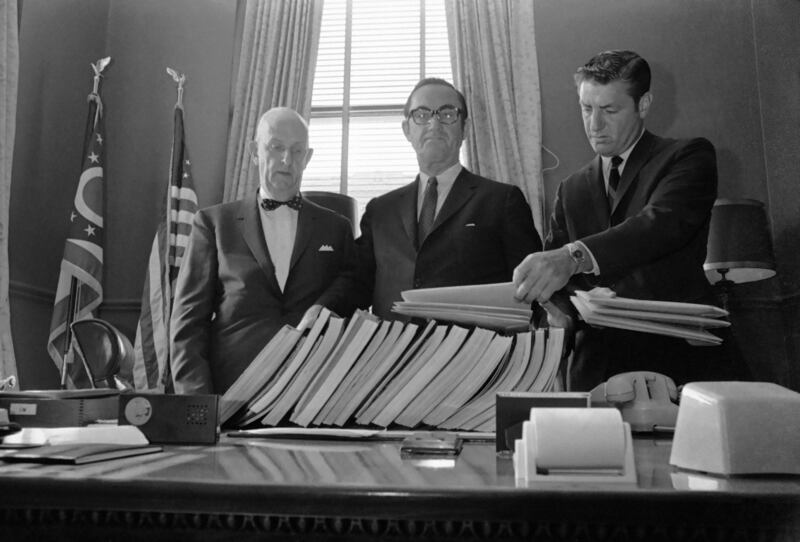
Kent State University shooting Ohio Attorney General Paul Brown, center, poses in his office in Columbus, Aug. 11, 1970, with Robert L. Balyeat, right, Lima attorney, and Seabury H. Ford, Ravenna attorney, as they start to go over the huge file of data on the shooting deaths of four Kent State students. A special Grand Jury has been called for later this month and Balyeat will direct the preparation and presentation of evidence. Ford is one of the assistants. The FBI report, which is said to be the size of all of these reports, will arrive on Wednesday. (AP Photo/Gene Herrick) (Gene Herrick/AP)
Kent State University shooting Thousands of anti-war protesters gather May 4, 1971, at the Justice Department. It was one year ago that the National Guard shot and killed four students at Kent State University in Ohio. (AP Photo) (ASSOCIATED PRESS)
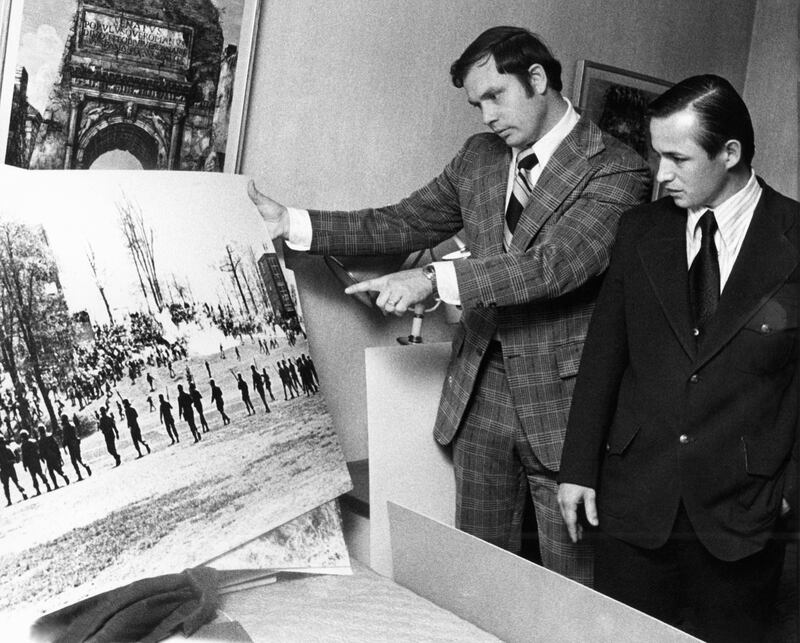
Kent State University shooting Two of the eight former Ohio National Guardsmen acquitted of charges stemming from the 1970 Kent State University shootings look at a mural-sized photo taken shortly before the gunfire erupted, Nov. 9, 1974. William E. Perkins, left, and Mathew J. McManus study the photo. (AP Photo/Julian C. Wilson) (Julian C. Wilson/AP)
Kent State University shooting Unidentified Ohio National Guardsmen who participated but were acquitted in the May 1970 shooting at Kent State University are shown signing their autographs on a photo of the guardsmen firing on the crowd, date unknown. (AP Photo) (ASSOCIATED PRESS)
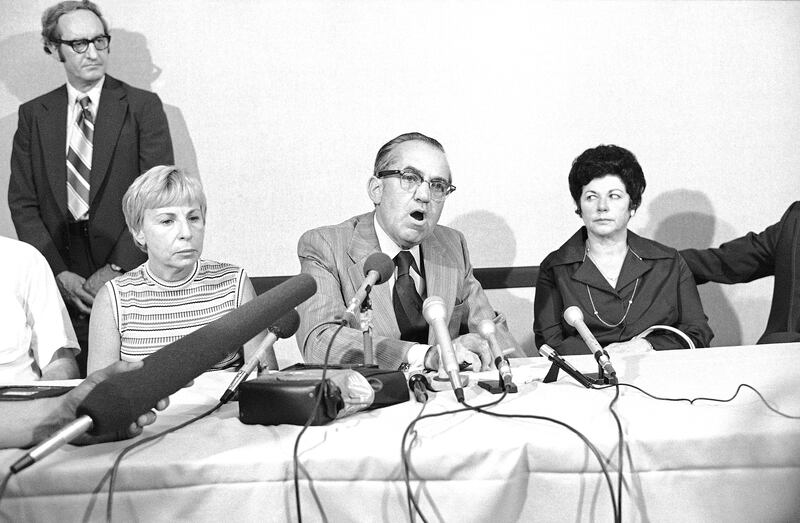
Kent State University shooting Joseph Kelner, lead lawyer for the victims of the 1970 Kent State University shootings and their families, said jurors who cleared Ohio Gov. James Rhodes and other defendants of liability for the incident ignored the volume of evidence. We had thought the lapse of five years would bring to us the elements of a fair trial, he said. We regret to say it did not. He said the verdict will be appealed. Joseph Kelner spoke to newsmen, Aug. 27, 1975 in Cleveland, Ohio, flanked by the mothers of two of the four who were killed in the incident, Elaine Miller Holstein, left, of Plainview, N.Y., and Sarah Scheuer of Youngstown, Ohio. (AP Photo/G. Paul Burnett) (G. Paul Burnett/ASSOCIATED PRESS)
Kent State University shooting Crosby, Stills and Nash perform their song "Ohio" on Sunday, May 4, 1997, on the campus of Kent State University in Kent, Ohio, to a crowd of approximately 7,000. The group's performance commemorates the 27th anniversary of the Kent State shootings on May 4, 1970. The group is in the area for induction into the Rock and Roll Hall of Fame and Museum on Tuesday in Cleveland. From left to right are Stephen Stills, Graham Nash and David Crosby. (AP Photo/Jeff Glidden) (JEFF GLIDDEN/ASSOCIATED PRESS)
Kent State University shooting Kent State University student Kari Coffin lays flowers on a memorial to Jeffrey Miller during ceremonies dedicating the site Wednesday, Sept. 8, 1999, in Kent, Ohio. Miller was one of four students killed by National Guardsmen during an anti-war protest May 4, 1970. (AP Photo/Mark Duncan) (MARK DUNCAN/ASSOCIATED PRESS)
Kent State University shooting A marker rests near where four Kent State students were shot 37 years ago, Tuesday, April 17, 2007, in Kent, Ohio. In a sign of what's to come for Virginia Tech, universities have struggled for decades with unexpected tragedies that became their signature, at times embracing the significance; at others debating how to deal with it. It took two decades to build a memorial at Kent State. (AP Photo/Tony Dejak) (Tony Dejak/ASSOCIATED PRESS)
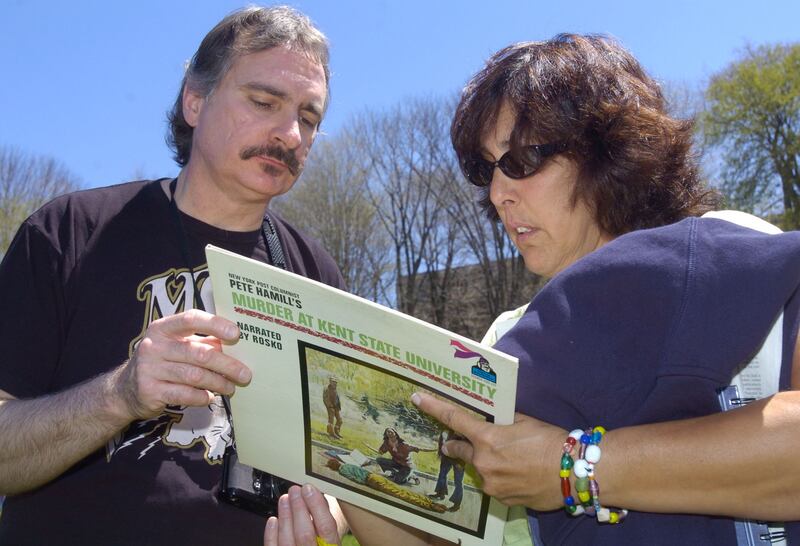
Kent State University shooting Tony Medwid, of Pittsburgh, receives an autograph from Mary Ann Vecchio, the young girl captured in the Pulitzer Prize-winning photograph of the May 4, 1970, shootings on the campus of Kent State University, Friday, May 4, 2007. Vecchio is signing an album which features an artist's rendering of the John Filo photograph which captured part of the event that left four students dead and nine wounded during anti-war protests in Kent, Ohio. (AP Photo/Jeff Glidden) (Jeff Glidden/ASSOCIATED PRESS)
Kent State University shooting ** FILE ** In this May 1, 2007 file photo, a student walks past a new Ohio Historical marker commemorating the 1970 Kent State University shootings on the campus in Kent, Ohio. Like a history book with its pages scattered from the sky, Ohio's landscape is bejeweled with state historical markers. There are currently 1,210, and the program that gave rise to them is celebrating its 50th birthday. (AP Photo/Mark Duncan, File) (Mark Duncan/ASSOCIATED PRESS)
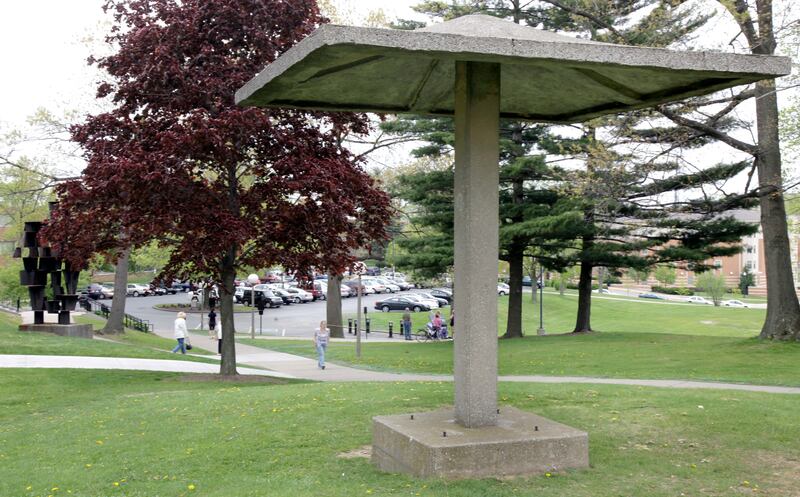
Kent State University shooting A father and his sons walk by the pagoda on the campus of Kent State University in Kent, Ohio on Saturday, May 1, 2010. On May 4, 1970, National Guard troops stood at this pagoda a fired into a crowd of students, killing four and wounding nine others during a Vietnam era protest on the campus. May 4, 2010 marks the 40th anniversary of the incident. (AP Photo/Amy Sancetta) (Amy Sancetta/AP)
Kent State University shooting On May 1, 2010, a flower lays on the granite marker at the location where student Allison Krause was shot and killed on May 4, 1970 on the campus of Kent State University in Kent, Ohio. During a Vietnam era protest on May 4, 1970, National Guard troops opened fire on a crowd of students, killing four and wounding nine others. May 4, 2010 marks the 40th anniversary of the incident. (AP Photo/Amy Sancetta) (Amy Sancetta/ASSOCIATED PRESS)
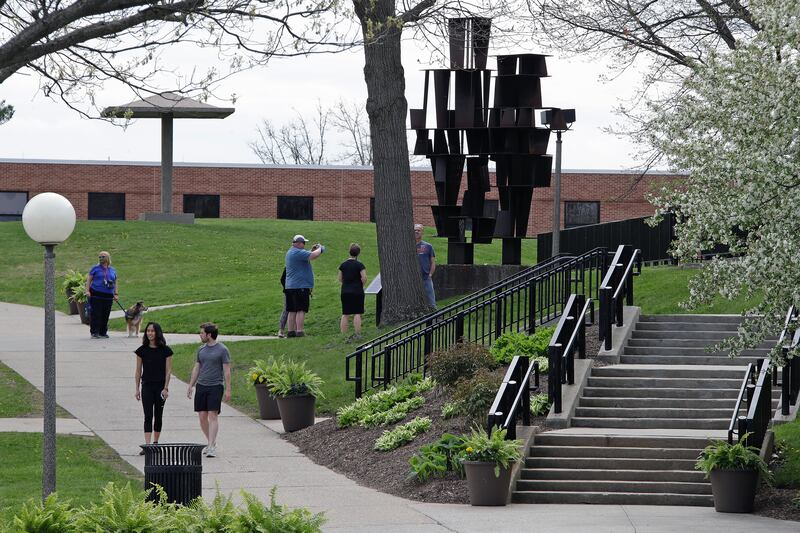
Kent State University shooting The pagoda stands on a rise at the front of Taylor Hall on the campus of Kent State University in Kent, Ohio on Saturday, May 1, 2010. On May 4, 1970, after days of anti-war unrest on the campus, National Guard troops stood at this pagoda and opened fire into a crowd of students below, shooting 67 rounds in 13 seconds, killing four and wounding nine others. People stand at center in the distance at the lighted posts marking the location where student Jeffery Miller died. The other three students who were killed were shot in the parking lot beyond Miller. May 4, 2010 marks the 40th anniversary of the incident. (AP Photo/Amy Sancetta) (Amy Sancetta/ASSOCIATED PRESS)
Kent State University shooting This is a memorial Sunday, May 3, 2020, on the Kent State University campus site where four students, Allison Krause, Jeffrey Miller, Sandra Scheuer and William Schroeder, were killed when Ohio National Guardsmen opened fire May 4, 1970 during a student protest against the escalation of the war in Vietnam. In addition to the four students killed, nine were wounded in the 13 seconds it took 28 guardsmen to get off 67 rounds. (AP Photo/Gene J. Puskar) (Gene J. Puskar/AP)
Kent State University shooting This is the top of Blanket Hill on Sunday, May 3, 2020 on the Kent State University campus in Kent, Ohio. It was from this position that Ohio National Guardsmen fired into a crowd of students protesting the escalation of the war in Vietnam on May 4, 1970. Four students were killed and nine were wounded in the 13 seconds it took 28 guardsmen to get off 67 rounds.(AP Photo/Gene J. Puskar) (Gene J. Puskar/AP)
Kent State University shooting Visitors to the Prentice Hall parking lot on the campus of Kent State University in Kent, Ohio, on Sunday May 3, 2020, pay their respects at markers indicating where student Jeffrey Glenn Miller, 20, fell mortally wounded when Ohio National Guardsmen opened fire from the hillside shown at top of photo, May 4, 1970, during a student protest against the escalation of the war in Vietnam. Four students were killed and five were wounded in the 13 seconds it took 28 guardsmen to get off 67 rounds. (AP Photo/Gene J. Puskar) (Gene J. Puskar/AP)
Kent State University shooting A man reads the Ohio historical marker commemorating the Kent State shootings, Monday, May 4, 2020, in Kent, Ohio. The Ohio National Guard opened fire on unarmed college students during a war protest at Kent State University on May 4, 1970. Four students were killed, and nine others were injured. Not all of those hurt or killed were involved in the demonstration, which opposed the U.S. bombing of neutral Cambodia during the Vietnam War. (AP Photo/Tony Dejak) (Tony Dejak/AP)
Kent State University shooting Visitors to the Prentice Hall parking lot on the campus of Kent State University in Kent, Ohio, pay their respects at markers indicating where fell mortally wounded when Ohio National Guardsmen opened fire on students during a protest against the escalation of the war in Vietnam, Sunday, May 3, 2020. (AP Photo/Gene J. Puskar) (Gene J. Puskar/AP)
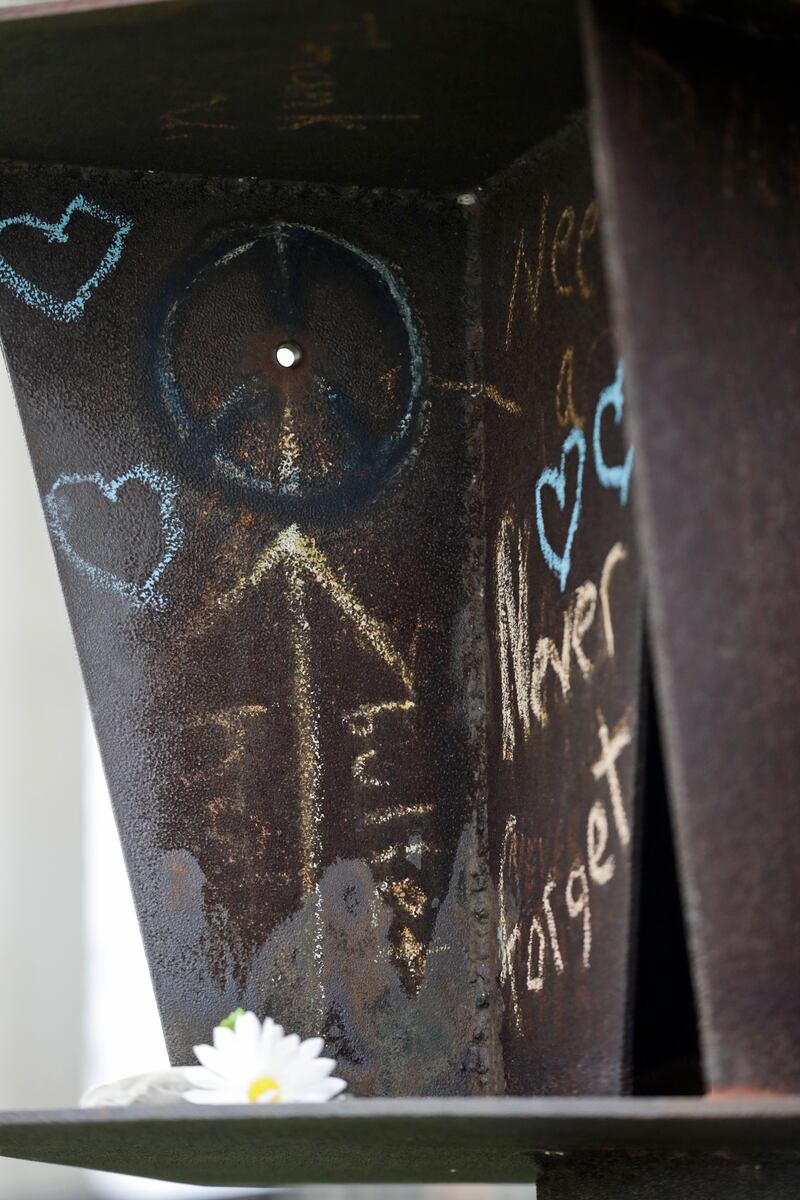
Kent State University shooting A bullet hole from 1970 is shown in a sculpture, Monday, May 4, 2020, in Kent, Ohio. The Ohio National Guard opened fire on unarmed college students during a war protest at Kent State University on May 4, 1970. Four students were killed, and nine others were injured. Not all of those hurt or killed were involved in the demonstration, which opposed the U.S. bombing of neutral Cambodia during the Vietnam War. (AP Photo/Tony Dejak) (Tony Dejak/AP)
Kent State University shooting The memorial for Sandra Scheuer is shown through a bullet hole in a sculpture, Monday, May 4, 2020, in Kent, Ohio. The Ohio National Guard opened fire on unarmed college students during a war protest at Kent State University on May 4, 1970. Four students were killed, and nine others were injured. Not all of those hurt or killed were involved in the demonstration, which opposed the U.S. bombing of neutral Cambodia during the Vietnam War. (AP Photo/Tony Dejak) (Tony Dejak/AP)
Doris Krause, Allison’s mother, said the family learned of her death from reporters who called their home. Rushing to Ohio, no one met her at the hospital. She told the Pittsburgh Post-Gazette in 2010 that the only acknowledgment they ever received was a partial reimbursement of Allison’s tuition, which arrived after the funeral in a check made out in the deceased student’s name.
On a campus where only 5% of students were Jewish it seemed an odd coincidence that three of those killed were Jews. As their lives were memorialized in the days after the shooting, the Jewish community took the lead, fighting to have plaques and commemorations held as the anniversary arrived with the Vietnam War still raging. More permanent markers were eventually placed in 1990, with yearly candlelight walks and vigils continuing to be held.
Investigations into the events leading up the shootings point to a contentious atmosphere between students and National Guardsmen brought in at the direction of Ohio Gov. James Rhodes. Threats were rumored to be circulating about the burning of the ROTC building on campus, which did end up in flames the following day.
Gov. Rhodes had visited the campus the day before the shooting and gave a speech to promote his run for U.S. Senate that highlighted his “law and order” platform. He called the demonstrators “the worst type of people we harbor in America” and promised to use “whatever force necessary to drive them out of Kent.” Gov. Rhodes ultimately lost his bid for the Senate, but was reelected as governor two more times after the shooting.
Krause’s family filed lawsuits against those involved, leading to cases that dragged on for years. Her father, Arthur, went on a public crusade to bring justice to the families of the students killed and accountability to those who gave the order to fire on unarmed students. Finally, in 1979, the Ohio State Controlling Board approved an out-of-court settlement that paid victims’ families $15,000 each and a signed “Statement of Regret” from Gov. Rhodes and the 27 National Guardsmen who were defendants in the case.
















/cloudfront-us-east-1.images.arcpublishing.com/cmg/XCUXZC2XYZHCRGNNGKFEX6U3LQ.png)


